East
Agios Nikolaos and Elounda
A small lake town and the resort village next door, sharing one of Crete's prettiest bays. The real argument for staying is everything you can reach from it.
The Venetians named this bay Mirabello, "beautiful view," and for once the marketing department got it right several centuries early. Agios Nikolaos sits at the head of it, on the northeast coast, about an hour east of the airport. Locals shorten the name to Ag Nik, which we'll do too. What everyone sees first is the lake.
The lake that isn't bottomless
Lake Voulismeni sits right in the middle of town, a near-perfect circle of dark green water dropped between the buildings and ringed almost entirely by cafes. A short channel connects it to the harbour, cut by French soldiers stationed here in 1907, which is why the lake is now brackish rather than fresh. Before that it was a closed pool, and that closed, unreadable surface is where the legends come from.
Most durable is the claim that it has no bottom. It does. About 64 metres of it — deep enough to feel mysterious when you're leaning over a railing with a frappé, but a measured, finite number, and divers have been down there. A second, more cinematic story has it draining all the way to the Santorini volcano, eighty-odd kilometres across open sea. It does not. Athena is also supposed to have bathed here, which we can neither confirm nor deny.
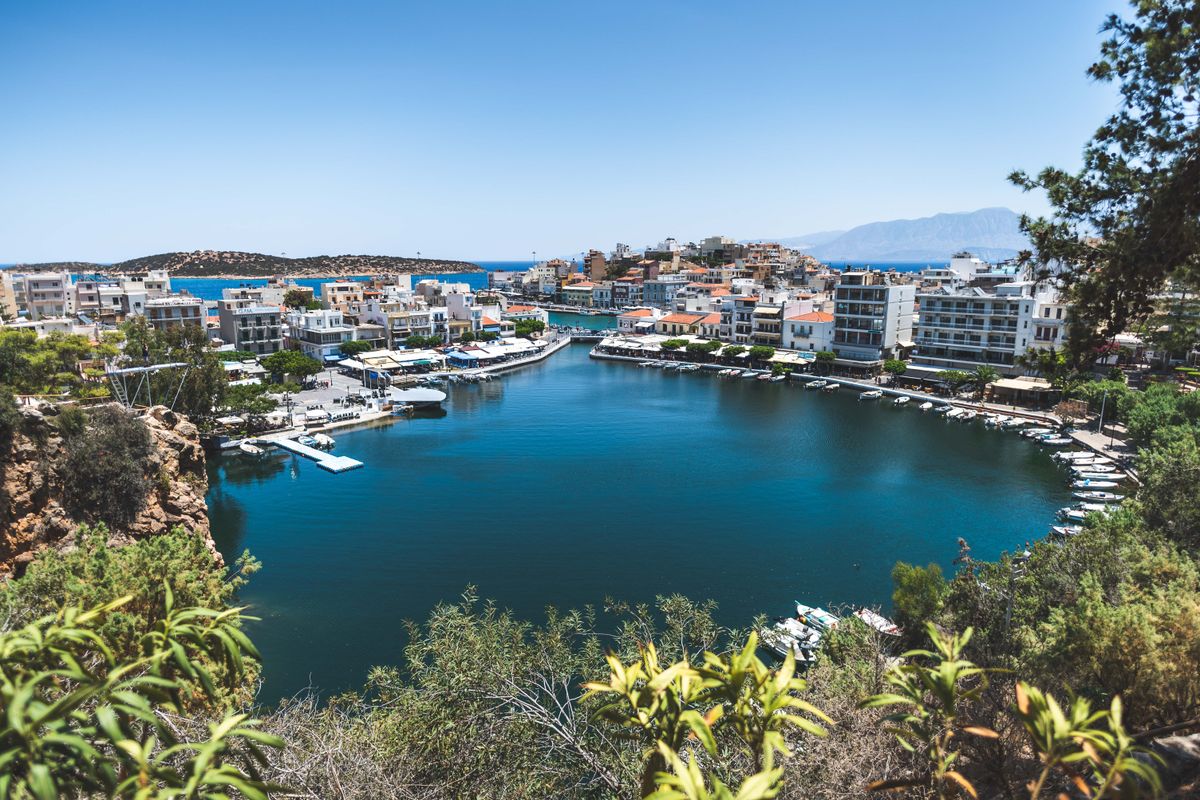
A few minutes from the lake is the harbour proper, where day boats tie up alongside fishing caïques and the occasional showy yacht. This is the part of Ag Nik that earns its living — a tight grid of waterfront restaurants and ice cream. Its beaches, Kitroplatia and Ammos chief among them, are serviceable rather than memorable. You can swim from them perfectly well; you would not cross Crete to do it.
Ag Nik, honestly
We should be straight about this, because the brochures won't be. Agios Nikolaos is pleasant. It is not spectacular. It's a comfortable, walkable, faintly glamorous resort town where you can eat well and watch the bay change colour as the afternoon wears on — a lovely way to spend an evening, and not, on its own, a reason to plant a whole holiday here.
What makes the town worth a base is its position. From here the east of the island opens up easily, and the things people actually remember from a Crete trip — the fortress island, the high mountain plain, the long beaches further on — sit within easy reach. Think of Ag Nik less as the destination and more as the front door.
Stay in Agios Nikolaos for the bay and the dinners, but build the days around the trips out. Treat the town as the place you come back to, not the thing you came for, and it never disappoints.
A rough sense of what's within striking distance:
- Spinalonga — Venetian fortress turned former leper colony, by boat from Elounda, Plaka or Ag Nik. The most-visited spot in this corner of Crete.
- The Lasithi Plateau — a green bowl of farmland ringed by mountains, with the cave where Zeus was supposedly hidden. Forty-five minutes up a switchback road.
- Vai and the far east — Europe's largest native palm forest behind a tropical-looking beach, a longer day toward Sitia.
- Kritsa and Panagia Kera — a hill village with some of the finest Byzantine frescoes on the island, twenty minutes inland.
Elounda, where the money goes
Ten kilometres north along the coast road, Elounda is a different proposition. This is where Crete keeps its big-name luxury resorts — the kind with private bays and a clientele that arrives by helicopter transfer — strung along the shore of the same Mirabello bay. The village centre is smaller and more polished than Ag Nik, the harbour quieter, the menu prices a notch higher.
You don't need to be staying in one of the grand hotels to enjoy Elounda. Its waterfront is pretty, the swimming calm and clear, and it's the most popular launch point for the Spinalonga boats. Even on a firmly mid-range budget, an afternoon and an early dinner here is a fair use of time. Just be aware which Crete you're in: this is the dressed-up one.
The city under the water
The thing in Elounda that most people walk straight past is, fittingly, mostly underwater. Where a narrow causeway crosses to the Kolokytha peninsula, just south of the village, lie the remains of Olous — a Greco-Roman port city that slipped beneath the surface, probably when an earthquake dropped the coastline around the eighth century.
Most of the city is gone, but not as far as you'd think. Water over the old harbour is shallow and astonishingly clear, and with mask and snorkel you can drift over the foundations — cut blocks and wall lines — a metre or two down. Beside the causeway, exposed to the sky, lie mosaic floors from an early Christian basilica, patterned with fish and birds, fenced but visible. No ticket booth, no fee. The whole thing is free, faintly surreal, and far less visited than it should be.
Bring your own snorkel gear and swimming shoes — there's nowhere to rent at the causeway, and the entry is stony — and go in the morning, before the wind gets into the bay. For the fortress out in the water, our entry on Spinalonga covers the crossing and how long to allow; for the day up the mountain, see the Lasithi Plateau.
Getting here and getting around
Heraklion airport is the practical gateway, around an hour west on the national road — a fast, dull, mostly four-lane drive along the north coast. Sitia has a smaller airport closer to the east, but far fewer flights. Buses run from Heraklion to Ag Nik through the day, and a local service shuttles up to Elounda and Plaka, useful if you're only here for the boat.
A car changes the maths. Spinalonga aside, almost everything worth doing from here — Lasithi, Kritsa, the far east, the quieter southern coves — assumes you can drive yourself, and buses that reach the headline sights will strand you for the rest. For more than a couple of nights here, sorting transport from the airport in advance, and ideally a car for part of the stay, is the difference between seeing the east and seeing the bay.
Boats to Spinalonga run from three places — Elounda (closest), Plaka (shortest crossing) and Agios Nikolaos (longest, most scenic). All are seasonal and weather-dependent, and the bay can turn choppy by afternoon, so an early sailing is the safer bet.
For detail on the island itself, the local we-love-crete guide to Spinalonga and its notes on Olous and the causeway are both worth a read first, and the municipal marina site for Agios Nikolaos and Elounda covers harbour and sailing specifics.
Spend a couple of nights, then. Eat by the lake, swim off Elounda, snorkel a drowned city, take the boat out to the fortress. Ag Nik won't dazzle you — but as a place to come back to each evening, with the whole east of Crete in reach, it's hard to argue with.