East · Mountains
The Lasithi Plateau and the cave of Zeus
A flat green basin held high in the Dikti mountains, reached by a road of hairpins. Come for the loop drive, the cool air, and the cave where a god was hidden — not for the postcard windmills, which have mostly gone.
You smell the Lasithi Plateau before you see it. Somewhere on the climb the air changes — drier, greener, a few degrees cooler than the coast you left an hour ago — and then the road tips over a pass and the basin opens out below: a flat floor of orchards and vegetable plots, maybe ten kilometres across, ringed on every side by bare grey mountain. It sits at around 840 metres, which is why it stays cool when the beaches are baking, and it is the largest upland plain on the island. We have driven up in different seasons, and the first sight of it still does something.
This page is the honest version. The plateau gets sold hard on day-trip brochures, usually with an inflated count of windmills and a soft-focus photo. Reality is better in some ways and thinner in others. Here is what is actually up there.
The road up is the first attraction
There is no flat way onto Lasithi. You climb to it, and the climbing is the point. Two main approaches do the work.
- From the north coast (Hersonissos, Malia, Stalida): the road threads up through Mochos and Krasi, then a long series of tight hairpins to the rim. This is the classic ascent and the one most tours take.
- From Agios Nikolaos and the east: a quieter, longer climb through the hills behind the Gulf of Mirabello. If you are already based in that corner — see our notes on Agios Nikolaos and Elounda — this is the natural way in.
Either way, take it slowly. Bends are sharp, drops are real, and you will meet tour coaches coming the other way with no enthusiasm for reversing. There is almost no public transport worth planning around; a sparse KTEL bus reaches Tzermiado from Heraklion, but it leaves you stranded for the cave and the villages. A car is not a nice-to-have here, it is the whole logistics. We say more about that in getting around Crete.
A ring of farming villages
The plateau is rimmed by a circle of small villages, set close together where the mountain meets the flat ground — they kept the field-floor for crops and built on the stony edge. Tzermiado is the largest and acts as the unofficial capital, with a couple of tavernas, a bakery, and a folklore museum if the timing suits. Agios Georgios has a small, sincere museum of plateau life. Psychro sits at the foot of the path to the cave and exists, frankly, to feed and park the people climbing it.
Drive the ring road and you pass apple orchards, almond trees, potato fields, and vines, all worked by hand on plots that look unchanged in decades. The produce is genuinely good — Lasithi apples and almonds turn up on menus across this side of Crete. Stop somewhere small for lunch. A plate of the local potatoes, some cheese, and whatever is in season will cost less and taste better than anything queued for at noon by the cave car park.
The plateau rewards the unhurried. Half a day if you only want the cave; a full, loose day if you want to circle the ring, eat slowly, and stop where a field or a chapel makes you.
About those windmills
This is where the brochures and the ground diverge. For a century or so Lasithi was farmed with thousands of small cloth-sailed windmills that pumped water up to irrigate the fields — at their peak there were said to be close to ten thousand white triangles turning at once. That image, the plateau as a sea of spinning sails, is the one still sold to you. It is essentially a historical photograph now.
Diesel pumps replaced wind decades ago. The cloth sails came down, the iron skeletons rusted, and most of the frames were dismantled for scrap or simply fell. Today you will see a scattering of bare metal stands by the fields, a handful kept up for photos, and that is it. There is no armada. We would rather you knew that on the drive up than felt cheated at the top.
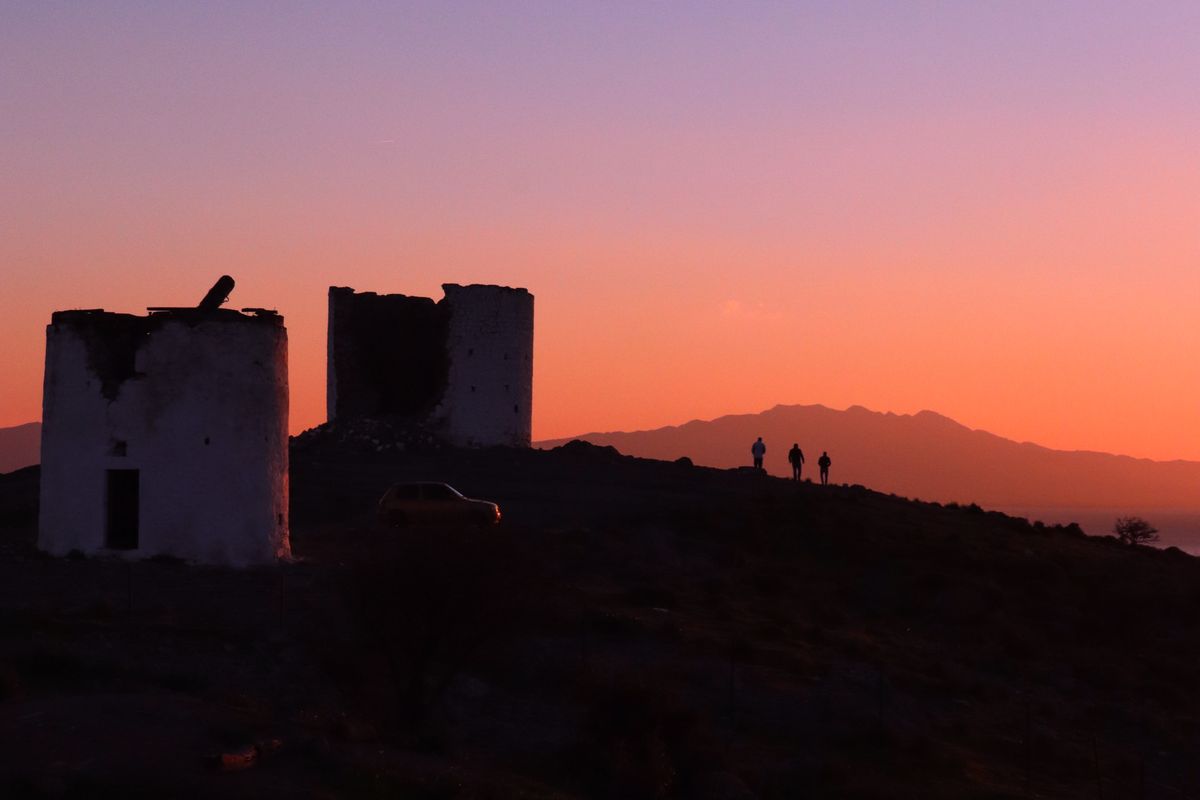
What does survive, and is worth the brief stop, is the cluster of stone windmills at the Seli Ambelou pass — the saddle you cross coming from the Heraklion side. These were grain mills, not water pumps, hauled up here in the nineteenth century. Most are roofless ruins now, cylinders of pale stone strung along the ridge against a big sky. As honest ruins they are far more affecting than any restored postcard would be.
The plateau runs a couple of degrees cooler than the coast and can be properly cold or fogged in spring and autumn mornings. Bring a layer even on a hot beach day; people regularly drive up in shorts and regret it on the cave path.
The Dikteon Cave, where a god was hidden
The reason most people come is the cave above Psychro — the Dikteon, or Psychro, Cave. In myth this is where Rhea hid the infant Zeus from his child-swallowing father Cronus, raising him in secret while the noise of clashing shields covered his cries. Archaeology backs the place up as a serious sanctuary: it was a cult site for many centuries, and excavators pulled bronze offerings and votives from its chambers. You can read the dry official account on the Dikteon Cave entry if you want the dates.
Getting in is a small workout. From the car park at Psychro it is a steep ten-to-twenty-minute climb to the mouth — stony, exposed, and a genuine slog in heat. You can pay for a mule to carry you up the worst of it, which is a private arrangement with the handlers at the bottom; we have always walked. There is a modest entrance fee at the cave itself.
Inside, a built stairway drops you down into a cool, dim, dripping chamber past curtains of stalactites and thick stalagmite columns, with a small still pool at the bottom. It is genuinely atmospheric, and genuinely slippery — the stone is wet, the light is low, and trainers with grip beat sandals every time. Take your time on the steps. The descent and climb back out are the only hard part of the whole day.
So, is it worth the day?
Yes — if you arrive with the right expectations. The plateau is not a spinning field of white sails and was never going to be. What it is: a wonderful hour of mountain driving, a cool green basin that feels a world away from the resorts, a ring of working villages with food worth stopping for, and a steep, mythic, dripping cave at the end of it. The official tourism board lists it among the island's set-piece sights for a reason — see Visit Greece on Crete — and a longer view of its history sits on its Wikipedia page.
Our shape for the day: drive up early before the coaches, do the cave first while your legs are fresh, then circle the ring road, stop for lunch in a village with no view of a car park, and pause at the stone mills on the way down. Pack a layer, wear shoes you can climb in, and treat the windmills as ghosts rather than a headline. Do that and Lasithi is one of the better days east of Heraklion.