Practical
Getting around Crete
Crete is bigger than people expect, and the way you choose to move around it decides how much of the island you actually see. Here is the short version, with the long version underneath.
Start with the shape of it. Crete is long and thin, roughly 260 kilometres end to end, and almost everything you have heard of sits in a narrow strip along the north coast: Chania, Rethymno, Heraklion, Agios Nikolaos. A fast road links them. Drop south of that line, or up into the White Mountains, and the map turns honest about how mountainous this place really is.
So the real question is not "car or bus" in the abstract. It is: are you staying on the north coast, or going past it?
The north coast spine, where the bus actually works
Along that top strip runs the E75, the national road — a proper two-lane highway for most of its length, fast, free of tolls, and the easiest piece of driving on the island. The intercity bus network, KTEL, shadows it almost perfectly, which is why public transport here is genuinely useful rather than a consolation prize.
Two regional companies run the show, and it helps to know which is which before you go hunting for a timetable. The western half (Chania and Rethymno, plus the routes out to the Samaria Gorge trailhead) is run by one operator; central and eastern Crete (Heraklion, Agios Nikolaos, Ierapetra, Sitia) by another. Heraklion has two separate stations to match, one for buses heading west and one for buses heading east, and tourists lose twenty minutes at the wrong one every single day. Western timetables sit on e-ktel.com; central and eastern routes are on ktelherlas.gr.
The fares are the good news. Heraklion to Chania, the full run across the top of the island, costs around €16 one way and goes hourly through the day; Heraklion to Agios Nikolaos is about €7.80. Buses are clean, air-conditioned, and run roughly from half five in the morning to mid-evening. If your plan is "land at Heraklion, base in an old town, take day trips up and down the coast", you can do the whole holiday without touching a steering wheel.
Where the bus quietly gives up
The trouble starts the moment you want the good stuff. South coast villages, the lagoon beaches in the far corners, the Lasithi Plateau with its windmill basin and the cave where Zeus was supposedly born — the bus either ignores these or runs one service a day, timed for locals rather than visitors. A few seasonal lines reach a handful of southern beaches in high summer, then vanish in the shoulder season.
Even the headline walks are awkward without a car. The Samaria Gorge works on the bus only because it is a one-way downhill route with a boat and coach laid on at the end — the exception, engineered for the crowds. Most of inland Crete is not.
If you want to be somewhere at sunrise, leave when nobody else is awake, or stop at the church-on-a-cliff that has no name on the map, you need a car. The bus is a tool for the coast, not for curiosity.
The hire car, which is the realistic default
For anything off the north coast, rent. A small car runs roughly €30 to €50 a day in season, less if you book ahead in spring or autumn, and the local Cretan firms tend to be cheaper and friendlier than the airport desks. Petrol hovers around €2 a litre, but distances are short enough that it rarely adds up to much.
A few things the rental-car version of Crete asks of you:
- Fill up on the coast. Stations thin out fast inland and south. A quarter tank in the mountains, plus the assumption you will pass a pump, is how people end up coasting into a village in neutral.
- Park outside the old towns. The Venetian cores of Chania and Rethymno are tangles of one-way alleys not built for cars. Leave it in a lot on the edge and walk in.
- Respect the map's optimism. A 40-kilometre mountain road can take well over an hour. The blue line looks like the highway; it is not.
- Take the smallest car you can stand. Wide hire cars and narrow village lanes do not forgive each other.
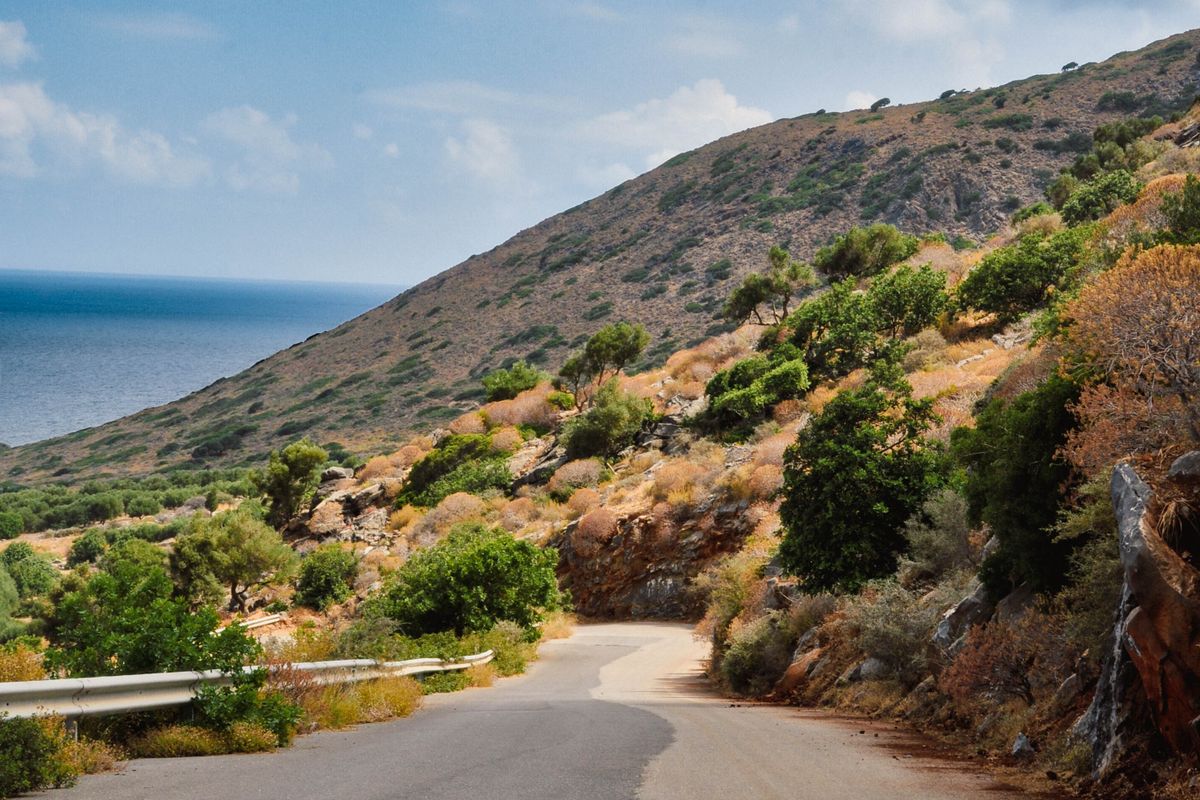
And then there is the driving itself, which deserves its own honesty. The E75 is fine; everything else is an education. Hard shoulders are rare on mountain roads, and where they exist, locals treat them as a slow lane — older drivers drift onto the edge so you can overtake, which is helpful right up until the moment it isn't. You will meet goats. They appear on blind bends with the calm of an animal that has never been asked to move. Take the corners slowly, assume the worst is around each one, and the south coast becomes one of the best drives in the Mediterranean rather than a white-knuckle ordeal.
A real example of the map lying: Heraklion to Matala on the south coast is only about 70 kilometres, yet it eats the best part of an hour because the last stretch winds. Plan inland and southern legs by time, not distance, and you stop being late for everything.
Distances worth memorising
These numbers shape almost every itinerary on the island. Times assume normal conditions and a sane pace:
- Heraklion to Chania — about 2 hours 30 minutes on the E75 (around 140 km).
- Heraklion to Rethymno — roughly 1 hour 15 minutes.
- Heraklion to Agios Nikolaos — about an hour.
- Heraklion to Matala (south coast) — about an hour.
- Chania to the Samaria Gorge trailhead at Omalos — around 1 hour 15 minutes uphill.
One fact catches almost everyone off guard: there are no trains on Crete. None. The island has never had a railway, so when a planning site offers a "rail option", it is guessing, and it is wrong. Your choices are wheels — yours or the bus's — and your own two feet.
Taxis, transfers and the airport run
For one specific job, neither car nor bus is the right answer: getting a tired group with luggage from the airport to where they are sleeping at an unhelpful hour. Crete's taxis are metered and regulated, but supply at Heraklion airport collapses the moment two flights land together, and a queue in the heat with three suitcases is nobody's idea of a holiday. For that first and last leg, a fixed-price car booked in advance earns its small premium — you walk out, someone is holding a sign, and you are gone. We cover the arrivals end of this in the piece on the Heraklion airport and getting onward.
For everything in between, treat taxis as a top-up rather than a system: a short hop from the bus station to a beach a few kilometres out, a late return when the last service has gone. Trying to tour the island by taxi will cost more than the rental car you should have booked in the first place.
So, what should you actually do?
If your Crete is a north-coast town and a string of day trips up and down the coast, take the bus, pocket the fuel money, and let someone else watch the road. It is cheap, frequent and far less stressful than the airport rental desks would like you to believe.
For everything else — the gorges, the south, the plateau, the beaches that take real effort to reach — rent a car, fill it before you leave the coast, and treat every mountain road as longer and narrower than the map admits. Crete rewards the people who go past the highway. It just asks you to drive like the locals do: slowly, and with one eye out for the goats.