Heraklion · Minoan
The museum that holds the Minoans
Knossos is mostly foundations and the odd reconstructed wall. The colour, the gold, the clay disc nobody can read — all of it lives ten minutes away, off Eleftherias Square.
The first thing to understand about the Heraklion Archaeological Museum is what it does for the rest of your trip. Walk Knossos cold and you get a hot hillside, cement stairs, and copied frescoes. Walk it after an hour here and the same site has people in it — bull-leapers, a woman holding snakes, a procession carrying cups. This is where the Minoan civilisation was carried, piece by piece, once the digs were done. The site is the address; the museum is home.
It holds the largest Minoan collection anywhere, drawn from Knossos, Phaistos, Malia, Zakros and the smaller settlements, and runs across two floors in rough chronological order — Neolithic and the early palaces downstairs, the frescoes and the high-palace material as you climb. No guide is needed to get the shape of it. What you do need is a couple of hours and the will to slow down, which is the one thing the layout quietly fights when a cruise group arrives.
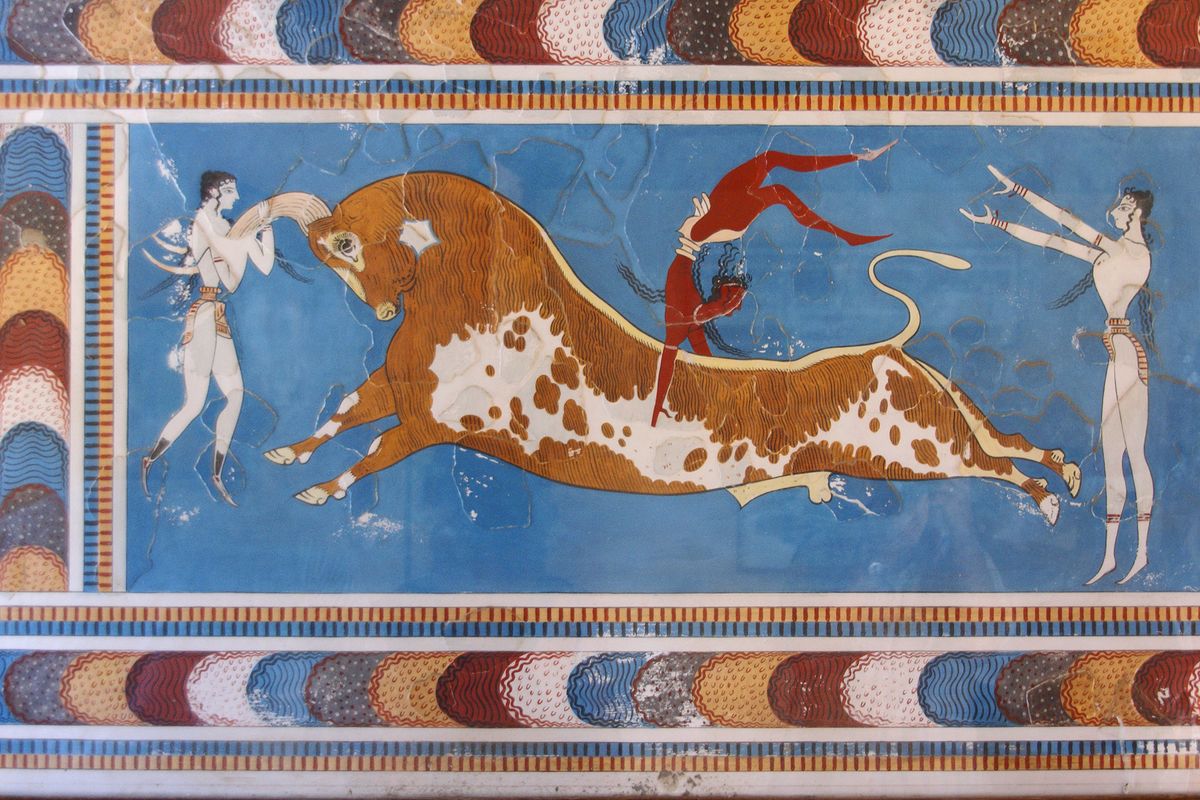
The frescoes, and the copy problem
Start at the top with the wall paintings, because they settle a question a few visitors feel quietly cheated by: why are the famous frescoes at Knossos so obviously not three thousand years old? Because the originals are here. What stands on site are facsimiles, placed roughly where the fragments turned up — partly to protect the real panels, partly because so little of each survived that reconstruction was the only way to read them at all.
The Bull-Leaping panel — the Toreador fresco, if you grew up with the old name — is the one everyone photographs: a bull mid-charge, an acrobat vaulting its back, a figure steadying it at each end. Up close you can see how little of it is genuinely ancient. The surviving fragments are the brighter, slightly raised patches; the muted infill between them is plaster from the early excavations. Same with the Prince of the Lilies and the procession figures nearby. Each is a collaboration between a Bronze Age painter and a 20th-century one, and once you can see the seam you stop reading them as photographs of the past and start reading them as arguments about it.
Pair them deliberately. See the panel here, then stand in front of its copy at Knossos and notice what the reconstruction added — the certainty, mostly. The two together teach you more than either does alone.
The Snake Goddesses, smaller than you think
Downstairs in the palace rooms are the two faience figurines usually labelled the Snake Goddesses, and the first thing that lands is the scale. Reproductions everywhere — book covers, fridge magnets, the side of a tour bus — make them feel monumental. The larger is barely a hand-span tall. She stands bare-breasted in a tiered skirt, snakes running up each arm, a small cat balanced on her headdress. Nobody is certain whether she is a goddess, a priestess, or a votive offering, and the museum, sensibly, does not pretend otherwise.
Made of glazed faience, moulded in parts and joined, they are technically remarkable for around 1600 BC, and they carry a charge that survives the souvenir-shop overexposure. If you read only one of our other entries before coming, make it the one on Knossos and how to read it — these figures came out of that same palace, and meeting them first helps you picture who once moved through those rooms.
The disc nobody can read
Then there is the Phaistos Disc, and you should give it more than the glance most people manage. It is small — about sixteen centimetres of fired clay — spiralled on both faces with forty-five distinct symbols, stamped into the wet clay with individual punches before firing. That detail matters more than it first sounds: it makes the disc, in effect, a piece of movable type, pressed out something like three thousand years before Gutenberg.
And after more than a century of trying, nobody has read it. Proposals run from a prayer to a board game to a calendar, none accepted; a few scholars have even floated forgery, though it is now generally taken as genuine. What I like is the restraint of the label — it tells you what is known, which is almost nothing, and leaves the mystery standing. In a museum that can feel reconstructed to within an inch of its life, the disc is the one thing that refuses to be explained.
The objects that reward a slow pass
A few smaller pieces are easy to walk past and worth doubling back for.
- The bull's-head rhyton — a ritual vessel of dark steatite, eyes of rock crystal and red jasper, muzzle inlaid with mother-of-pearl, the gilded wooden horns restored. The most arresting object in the building, and smaller than the postcards suggest.
- The gold bee (or wasp) pendant from Malia — two insects curved around a honeycomb disc, filigreed with a delicacy hard to square with the Bronze Age date.
- Kamares ware — palace pottery in white, red and orange on near-black, some thrown so thin it is called eggshell ware. The shapes feel oddly modern.
- The seals and signet rings — tiny carved stones, easy to miss, packed with bulls, goddesses and double axes. Bring the patience to lean in.
None of these is large. The museum's great theme, if it has one, is that the Minoans worked at the scale of the hand — jewellery, seals, figurines, cups — and that the monumentality we project onto them is partly our own.
The practical shape of a visit
The museum sits in the centre of Heraklion, a short walk off Eleftherias Square and easy to fold into a morning in the old town. Buy the combined ticket covering both this and Knossos — sold at either, cheaper than two singles, and valid for three days with one visit each, so you are not forced into both on the same exhausting day. Hours shift between the winter and summer timetables, with a longer evening on one midweek day, so check the museum's own visiting page before you commit a slot.
Time it against the harbour. Cruise groups tend to flood the upstairs galleries late in the morning and the rooms with the frescoes and the Snake Goddesses get loud and slow. Arrive at opening, or come in the last ninety minutes before close, and you can stand in front of the disc without queuing for it.
Two hours is a fair allowance — enough to see what matters without the gallery-fatigue glaze that sets in around hour three. There is a small café and a decent shop. Got a connoisseur in the group? Give it longer; the seals and smaller frescoes reward it. For the wider chronology, the Greek Ministry of Culture's cultural portal is the dry-but-reliable source, and Knossos keeps its own seasonal calendar — confirm it on the official city of Heraklion listings before you build the day around it.
So, the honest verdict
Do not speed through it, and do not treat it as optional. The temptation on a tight Crete itinerary is to do Knossos for the name and skip the museum because it is "just artefacts" — which gets it exactly backwards. The site is the ruin; the meaning is here. Snake Goddesses and disc aside, the case is already made — and they come surrounded by frescoes, gold and pottery that turn an abstract civilisation into a specific one.
Go before or after Knossos, whichever suits your day, but go to both. Lead with the museum and you reach the site already able to populate it; lead with the site and you come here to meet the people who lived in it. Either order works. Skipping one of them is the only real mistake.