Heraklion · Minoan
Knossos, and how to read it
Europe's oldest palace sits five kilometres south of Heraklion — and a good half of what you walk through was poured in concrete by a wealthy Englishman a century ago. Knowing which half changes everything.
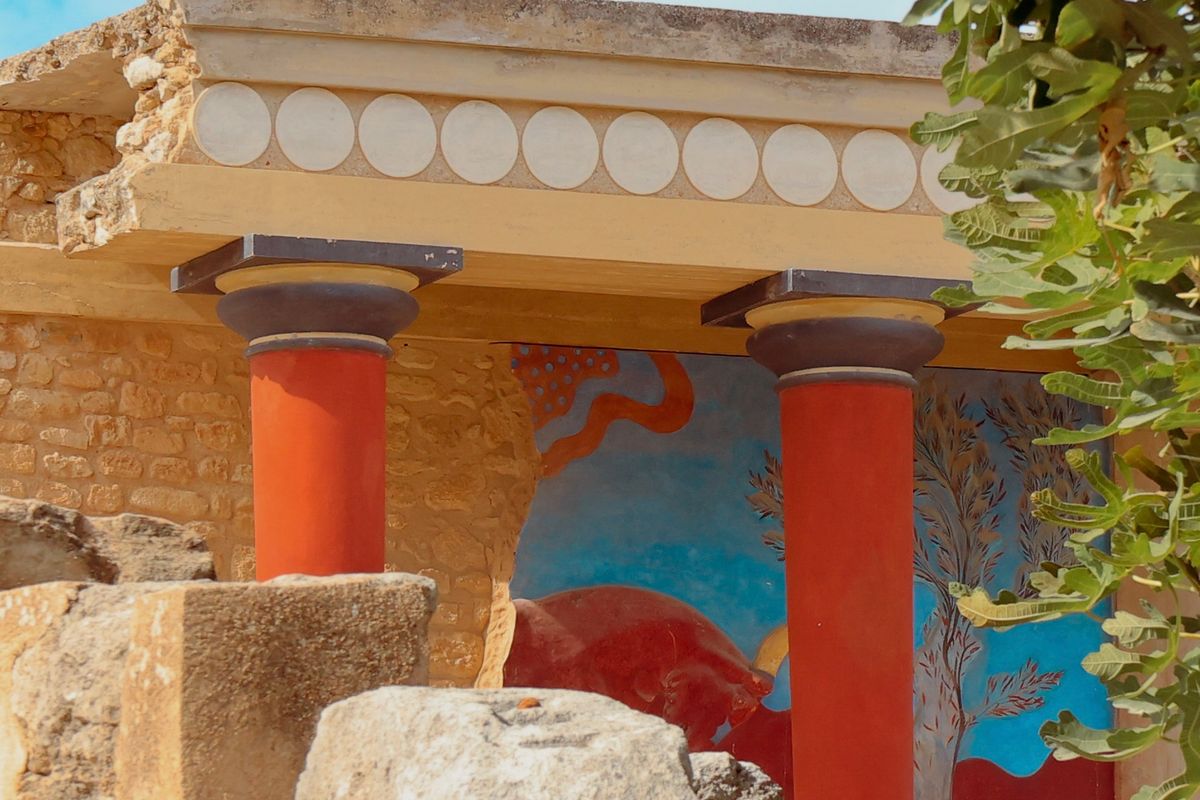
Most people feel mild confusion when they first arrive at Knossos. You expect tumbled stones and a placard; instead there are blood-red columns, a painted bull mid-charge, walls in ochre and Aegean blue. It looks less like a ruin than a film set, and in a sense that is exactly what it is. This is the largest Bronze Age site on Crete, seat of the Minoans, settled from roughly 7000 BC and built into a sprawling palace by around 1900 BC — one of the oldest "cities" in Europe. It is also, in large stretches, a reconstruction, and you will get far more out of it if you walk in knowing that.
We have brought sceptical friends here who left annoyed ("it's fake") and others who left thrilled. The difference was never the site — it was whether they understood what they were looking at first.
What is actually ancient here
Strip away the paint and the new concrete and there is a real, enormous thing under your feet. The palace footprint — around 20,000 square metres at its peak, more than a thousand interlocking rooms over several storeys — is authentic. The central court, the storage magazines with their giant clay pithoi (some big enough to hide a person), the foundations, the drains, the lower courses of stone: all Minoan, three and a half thousand years old, where it has always sat.
What the Minoans did not leave behind was the upper architecture. Their columns were painted timber on stone bases, and timber does not survive. Frescoes came out of the ground in fragments the size of a hand. That famous "labyrinth" plan, the warren later Greeks turned into the Minotaur myth, is real; the soaring red-columned façades that make the site so photogenic are a modern guess at what once stood there.
Arthur Evans, and the palace he half-invented
Responsibility lies with Sir Arthur Evans, a British archaeologist who bought the hill, began digging in 1900, and spent three decades not just excavating Knossos but rebuilding it. He called it "reconstitution" — a polite word for a great deal of guesswork rendered in reinforced concrete. Where his team found the burnt sockets of wooden columns, they poured concrete replacements and painted them red; where they found a few square centimetres of plaster, artists completed whole frescoes around the scraps.
Working in the Edwardian era, Evans produced a palace that looks, frankly, a little Edwardian: confident colours, clean lines, a certain Art Nouveau swagger that owes as much to 1905 as to 1500 BC. Archaeologists are split. Some call it vandalism that froze one debatable reading in permanent concrete; others note that without his roofing, the fragile gypsum beneath would have dissolved in a few Cretan winters. Both are right — the honest, uncomfortable truth of the place.
You are not looking at the Minoan palace. You are looking at one brilliant, opinionated Englishman's idea of it, built on top of the real one. Read it that way and it becomes fascinating rather than fraudulent.
None of this is a reason to skip Knossos — only to look at it with your eyes open. Reconstructed sections like the throne room, grand staircase and north entrance are the most vivid and the most invented. Off to the sides, the storage rooms and bare foundations are where you actually touch the Bronze Age. Spend time in both.
The frescoes are copies — the originals are in town
Every painted scene on the walls at Knossos is a replica. The Bull-Leaping fresco with its acrobats vaulting a charging bull, the "Prince of the Lilies", the blue dolphins, the griffins flanking the throne — all reproductions, fixed in place during or after Evans's work. The fragile originals, the genuine Minoan plaster that came out of this ground, live a few kilometres away in the Heraklion Archaeological Museum, in climate-controlled rooms where they belong.
Here is the single most useful planning point we can give you: see the palace and the museum together, ideally across the same day or two, and visit the museum after the site. Standing before the actual fragments in town, you grasp how small the surviving scraps were — and how much imaginative leaping Evans's painters did to build the scenes you photographed at Knossos. The two halves explain each other; one without the other is a story missing its ending.
Field note
A combined Knossos + Heraklion museum ticket is the obvious move. It costs less than two separate entries, skips a second queue, and is valid across a few days — so you needn't cram both into one sweaty afternoon. Buy it at whichever you reach first.
What to actually walk towards
Signage on site is thin — a few discreet panels and a lot of unmarked corridors — so it helps to know what you are aiming for. Three things are worth crossing the court for:
- North Entrance. A dramatic ramp flanked by a restored portico and the relief of a charging bull against ochre. Pure theatre, heavily reconstructed, the photo everyone takes. Take it anyway.
- Throne Room. A small, low chamber with a worn gypsum throne — one of the oldest seats of its kind in Europe — among reproduction griffin frescoes. You view it from a railing, and it is smaller than the photographs suggest, which is part of its strange power.
- Grand Staircase. Evans's showpiece, dropping into the eastern quarter over several flights around a central light-well. Clever, bold, one of the most reconstructed corners of the site. Admire the engineering; remember the date.
Beyond those, wander the west-side storage magazines, where rows of pithoi still stand in their bays, and find the giant stone horns of consecration near the south end — a Minoan religious symbol, far older in spirit than anything the columns suggest. There is no actual maze, but the plan really is a baffling tangle of rooms, and you can see why a later imagination filled it with a monster.
Getting there, and getting it right
The bus is genuinely easy
No car or tour is needed. Heraklion city bus line 2 runs from the centre — pick it up near the port bus terminal — out to the site every fifteen to twenty minutes. The ride is about twenty minutes and a single ticket is a couple of euros (cheaper from a kiosk than from the driver, as ever in Greece). The stop sits right by the entrance; cross the road and you are there. Afterwards it is easy to roll back into Heraklion's old town for a late lunch.
Tickets, timing and the heat
Standalone admission runs in the region of €15. A combined ticket with the Heraklion museum costs more upfront but saves money overall and is the smarter buy, as covered above. Budget an hour and a half to two hours on site — longer with a guide, shorter if you blast through.
Going at midday is the single biggest mistake. Knossos has almost no shade — a few trees, the odd canopy, otherwise open stone that bakes. Crete in summer is unforgiving by lunchtime, and that is precisely when cruise-ship coaches from the port disgorge their crowds onto the same narrow ramps. Go early, soon after opening, or in the last couple of hours before close, for cooler air, thinner crowds and far better light. Bring water and a hat; there is a café by the entrance but nothing inside.
Guide or no guide?
Because the panels tell you so little, a knowledgeable guide earns its keep here — pointing out, room by room, what is original and what Evans dreamed up, which is the whole game. Licensed guides wait near the entrance, or you can pre-arrange one. Going alone is fine too; just read a little first or download a decent site plan, otherwise you risk wandering past the throne room without realising it. For the excavation history, the Wikipedia entry on Knossos is genuinely good.
So, is it worth it?
Yes — with one condition. Walk in expecting an untouched window onto the Bronze Age and you will feel vaguely cheated. Walk in understanding that you are half-reading a careful, gorgeous, slightly fictional reconstruction laid over a very real ancient palace, and it becomes one of the most thought-provoking places on the island — archaeology and the history of archaeology stacked on the same hill.
Pair it with the museum, dodge the midday coaches, and give yourself time in the bare corners as well as the photogenic ones. Knossos rewards a visitor who reads it correctly far more than one who simply photographs it. For official details and opening hours, the Greek Ministry of Culture's Knossos page is the authority, and Incredible Crete has a useful overview for first-timers.