Heraklion
Heraklion, beyond the ferry traffic
Most people meet Heraklion at the airport belt or the ferry ramp and leave within the hour. Give the old town half a day on foot and a working Cretan city shows up — walls, a fortress, a fountain with four lions, and lunch worth sitting down for.
Heraklion gets a bad rap, and some of it is earned. The traffic is loud, the seafront road is no postcard, and plenty of buildings went up fast after the war. Most visitors treat the place as a turnstile — land, grab a hire car, drive west to Chania or south to the beaches. That's a mistake without first walking the centre, because the historic core is small, almost flat, and packs more real Cretan life into a few blocks than any resort strip on the island.
The whole walkable old town fits inside the Venetian walls. You can cross it in twenty minutes if you march. Don't.
Walls you can walk, and the man buried on top
The Venetians spent the better part of a century turning Candia — their name for the city — into one of the most heavily fortified ports in the Mediterranean. The result is a ring of earthwork ramparts roughly four kilometres long, thick enough to drive a cart along the top, with six arrow-shaped bastions at the corners. They held off one of the longest sieges in European history before the city fell. Much of the circuit survives, with stretches of the rampart top open to walk.
The corner that matters most is the Martinengo bastion, on the southern side — the highest point of the walls, and it holds a grave. Nikos Kazantzakis, the Cretan novelist behind Zorba the Greek, was born here in 1883. The Orthodox Church had quarrelled with him over his books and refused him a plot in consecrated ground, so the city put him on the bastion instead, under a plain wooden cross and a slab of rough stone. The epitaph he chose for himself is cut into it:
I hope for nothing, I fear nothing, I am free.
It's a short, unfussy spot — no ticket, no railings to speak of — and the view sweeps over the rooftops to the sea and, on a clear day, Mount Yiouchtas to the south. Local teenagers come up here to sit on the wall at dusk, which tells you it's less a tourist set-piece than a place the city uses.
The Koules, the harbour and the obvious photo
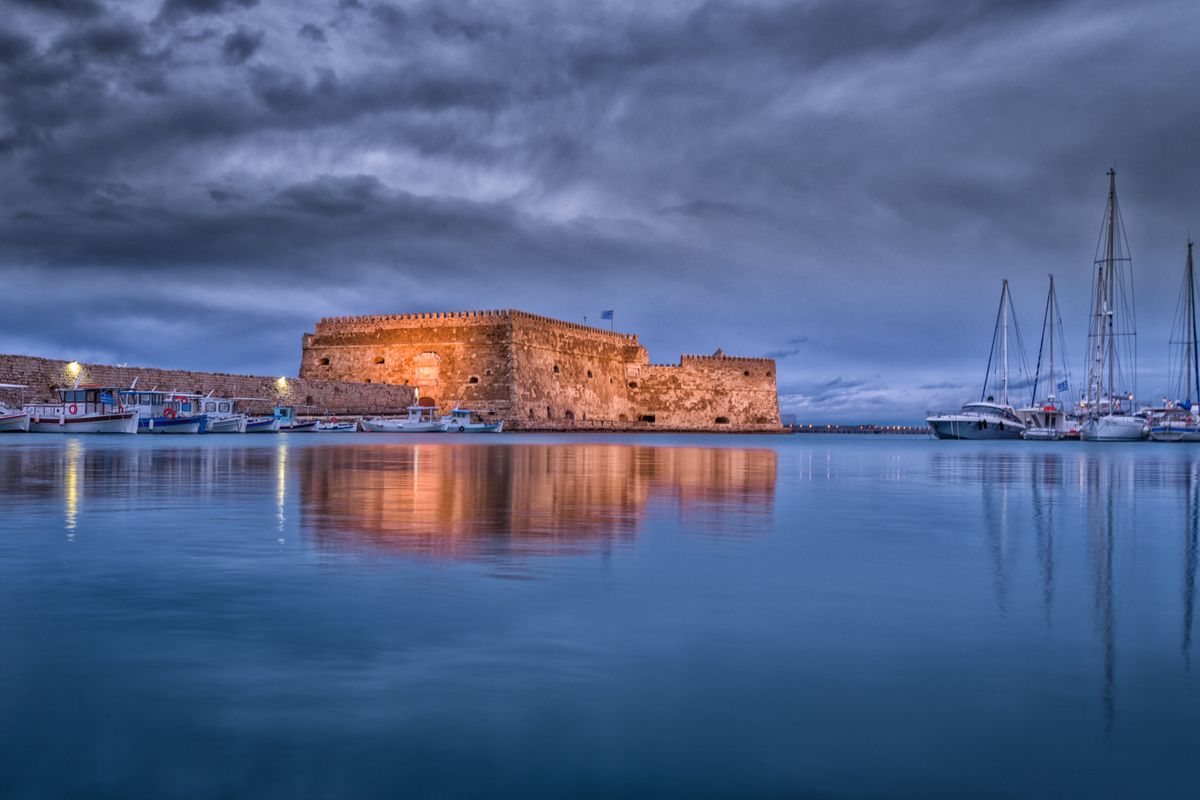
Walk north and everything funnels down to the old harbour. Out at the end of the mole sits the Koules, a low square fortress the Venetians called Rocca a Mare — the rock in the sea. It went up in the sixteenth century to guard the harbour mouth, a brute of a building: no spires, no decoration, just metres of honey-coloured stone and the carved Lion of Saint Mark where the spray can't reach.
You can go inside for a few euros, worth it for the vaulted gun rooms and the walk along the battlements. Mostly, though, people come for the outside — the causeway to it is the one stretch of Heraklion everyone photographs, and at sunset it earns the attention. Behind it, the marina fills with fishing boats and the odd yacht, and old men sit on the quay with rods that rarely catch much.
Field note
The causeway is exposed and gets genuinely windy — a meltemi day will sandblast you. Bring a layer even in summer, and hold onto hats and loose pages. We've lost a map to the harbour here.
Lions, a fountain, and the spine of the town
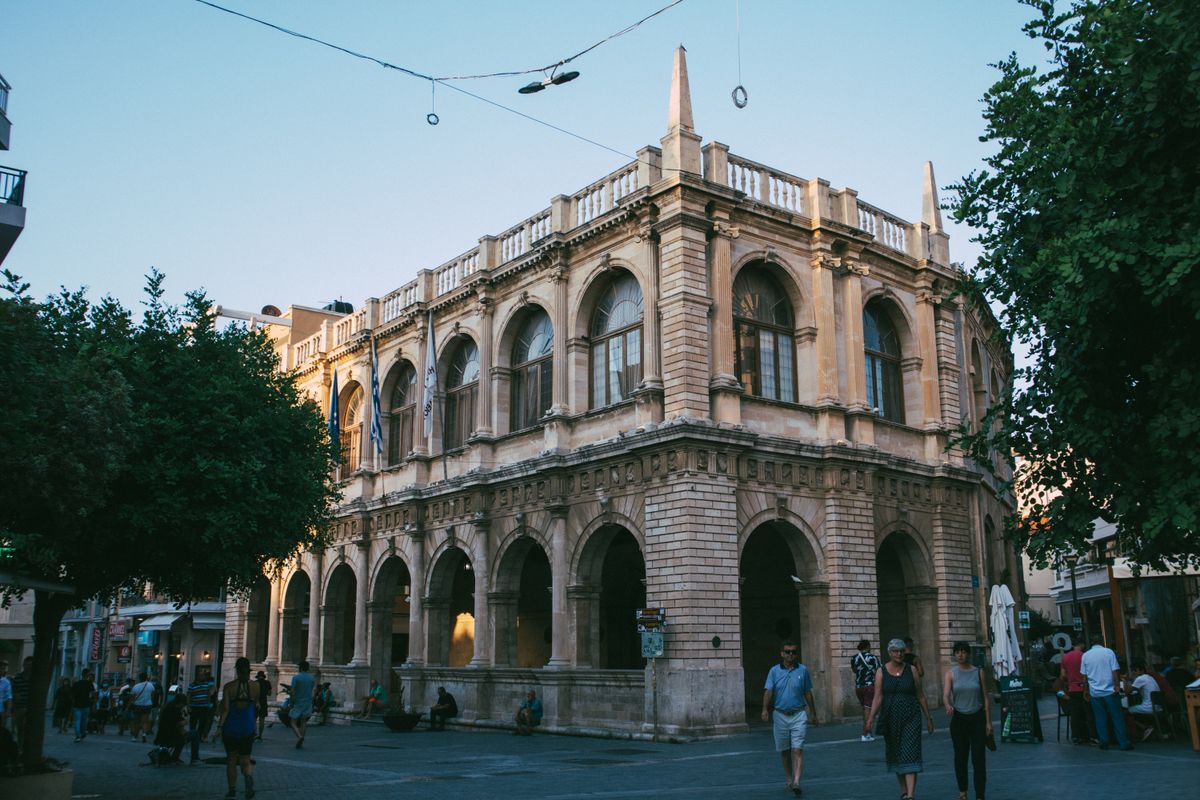
Inland, the pedestrian street called 25th August climbs gently into the old town. It's the city's spine, lined with neoclassical facades that survived the bombing and the Venetian Loggia — an arcaded building from the 1620s, now the town hall. Halfway up stands Agios Titos, the church of Crete's patron saint, a relic of the saint kept inside.
The street ends at the heart of the matter: Lion Square, properly Eleftheriou Venizelou, where the Morosini fountain has stood since 1628. Four stone lions hold up the basin, water still running from their mouths, and the square is ringed with cafes that fill from breakfast to past midnight. It's the city's living room — order a freddo espresso, claim a chair, and watch Heraklion go about its afternoon.
A block south, the covered market street — everyone calls it the 1866, after the year of a Cretan revolt — runs as a narrow corridor of stalls under awnings. It's the part we'd send anyone to first:
- Barrels of green and black olives, and the hard barley rusks (paximadi) that go under every Cretan salad.
- Wheels of graviera and tubs of soft mizithra, often with a slice pressed on you to taste whether you asked or not.
- Thyme honey, dried mountain herbs sold by the fistful, and bottles of unlabelled raki with a great deal of personality.
- Leather sandals, sea sponges, and the cheap kitchenware that's somehow more tempting on holiday.
It's touristed at the harbour end and more local as you go deeper. The further you drift from the fountain, the more it stops performing.
Where the half-day fits
Heraklion makes more sense as a base than most people credit. The centre is small enough to do on foot in an afternoon, and it sits dead centre of the island's attractions. The big draw is up the hill at Knossos, twenty minutes out on the number 2 city bus from the station near the port. But the find that anchors the city is in the old town — the archaeological museum holds nearly everything dug out of Knossos and the other Minoan sites, frescoes and all, and a Knossos visit makes half the sense without it.
A clean plan for a day: museum first thing, before the cruise crowds and the heat; an hour at Knossos either side of lunch; then the walls, the harbour and the fountain in the late afternoon when the light softens. One unhurried day covers the lot.
The city itself wants nothing more than your feet. The airport sits barely four kilometres east of the centre — close enough that a short taxi or a pre-arranged car door to door is the painless way in, and you can leave any hire car for the day you actually drive out. Inside the walls, parking is a fight you don't need to pick.
The honest verdict
Heraklion is not pretty the way Chania's lamplit harbour is pretty, and anyone who says otherwise is selling something. It's a working city of 150,000-odd people, with the noise and concrete that go with one. What it has instead is the museum, the walls, a real market, some of the best casual eating on the island, and not a single illusion about itself.
Give it the half-day. Skip it and you've driven straight past the most interesting thing the centre of Crete has to offer — which, given how many people do exactly that, is part of why it stays so unbothered. For opening times and the current Koules ticket, the city's own municipal pages are the place to check, and Lonely Planet's Heraklion guide is a sober second opinion.