West
Chania, the Venetian harbour town
A horseshoe of faded Venetian houses, a stubby Ottoman lighthouse, and a tangle of lanes that change name every fifty metres. Most people who see Chania once decide it is the best-looking town on Crete. We are inclined to agree — with a few caveats about where you eat.
What you notice first is the curve. The old harbour wraps around in a long arc, and at its open end stands the lighthouse, small and weathered, looking like it might topple into the sea if a big enough ship went past. It does not. It has stood there in one form or another for more than four centuries, which is longer than most lighthouses anywhere have managed to stay upright.
Chania sits in the far west of the island. From Heraklion it is roughly two and a half hours by road, but most people who want the west fly straight into Chania's own airport (CHQ) and skip the drive. Either way, the old town is the reason you came, and it is small enough to cross on foot in fifteen minutes — if you do not get lost, which you will.
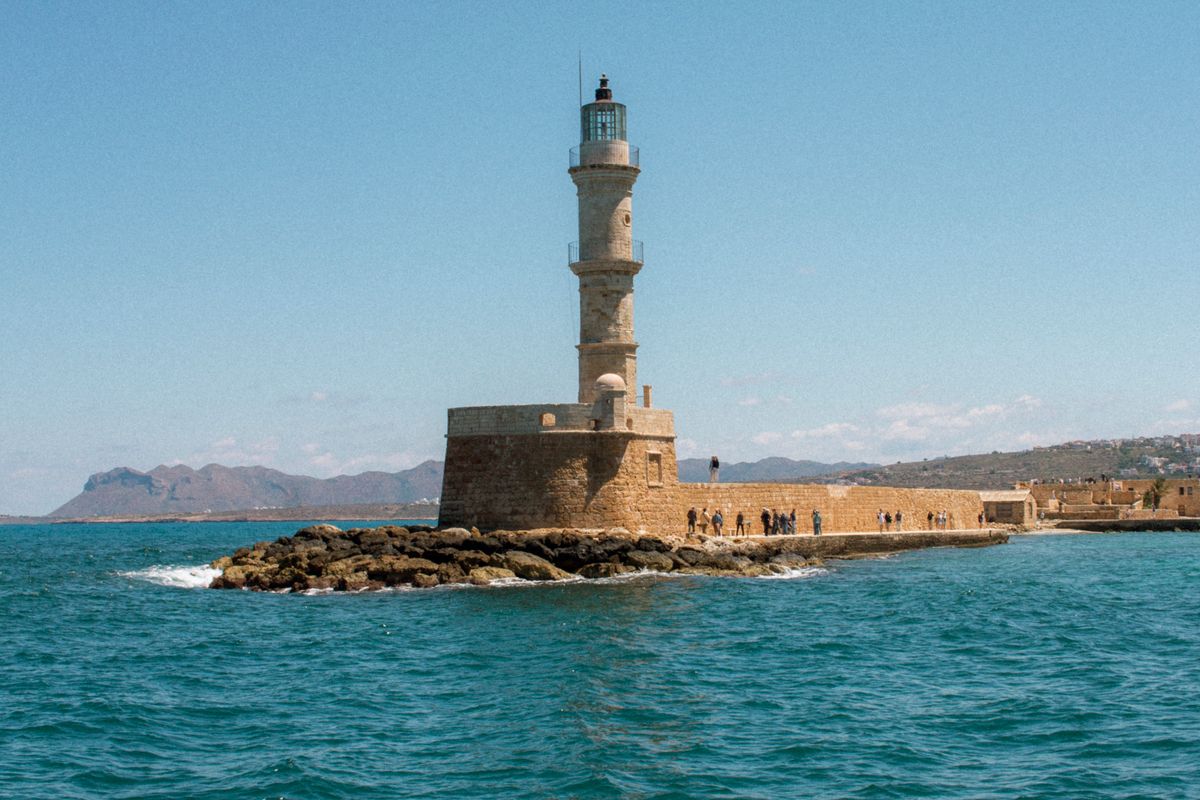
That lighthouse, and why it looks the way it does
Venice built the original at the mouth of the harbour around the turn of the seventeenth century, a defensive marker for ships coming in. What you see now is mostly the Egyptian rebuild from the 1830s, when troops under Ottoman command reshaped it into the tapered, minaret-like tower that gives it its odd silhouette. Hence the name everyone uses — the Egyptian lighthouse — even though Venice laid the first stones.
You can walk the full breakwater out to it — uneven stone, no shade, so go early or late. It is about a quarter of a mile each way and worth every step, because the postcard view of Chania is not from the harbour cafés. It is from out here, looking back.
Chania is a town that was conquered and re-conquered, and it never bothered to tidy up afterwards. Venetian arches, Ottoman wooden balconies, a Byzantine wall, a Greek flag over all of it — they simply stacked on top of each other and stayed.
Reading the layers: Venice, then the Ottomans, then now
The harbour itself is pure Venice. Look along the eastern arm and you will find the neoria — the Venetian arsenals, a row of huge vaulted stone shipsheds where galleys were built and repaired from the late fifteenth century onward. Seven survive. When the Ottomans took the city they stopped building ships there and used the sheds to store grain through their sieges instead. A couple now host exhibitions; the rest just stand open-mouthed at the water, and they are the most genuinely old thing on the whole waterfront.
The Ottoman mark is just as easy to read once you know what to look for: the domed mosque on the quay (the Küçük Hasan, often called the Yali mosque, now an exhibition hall), the carved wooden upper storeys jutting over the lanes, the minaret that lost its top. Greece added the obvious — the cafés, the churches reclaimed from mosques, the daily life.
The quarters worth your feet
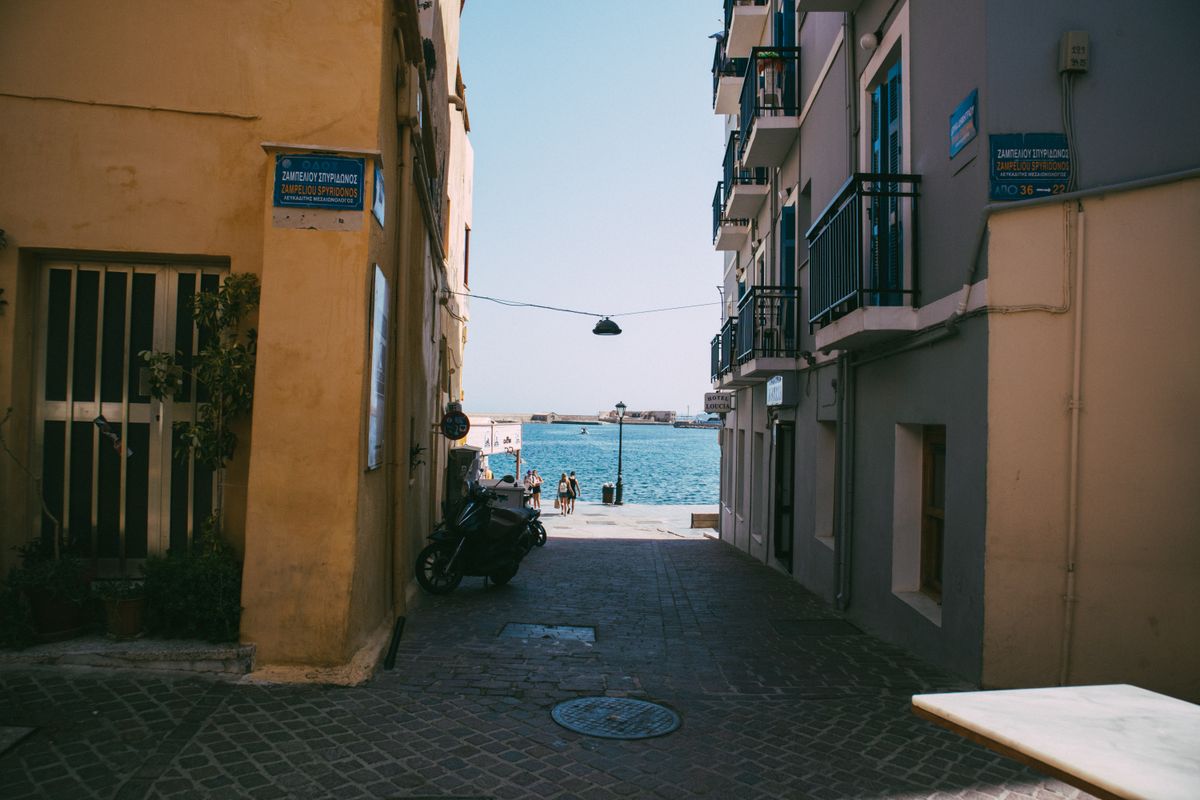
Inland from the water the old town breaks into distinct neighbourhoods, and wandering between them is the real pleasure of Chania.
- Topanas — the smart western quarter behind the Firkas fortress, all tall Venetian townhouses and narrow shaded lanes. This was the Christian district under Ottoman rule. It is the prettiest part and, predictably, the one most given over to boutique hotels.
- Splantzia — east of the harbour, built around a quiet plane-tree square (Plateia 1821). For a long time this was the Turkish quarter. It is now where you go to escape the crowds: proper neighbourhood tavernas, a slower pace, washing strung between balconies.
- The former Jewish quarter (Evraiki) — the warren of lanes just behind the western harbour, centred on the restored Etz Hayyim synagogue. Small, sombre, and easy to walk straight past if you do not know it is there.
The fortress, the market, and the leather street
At the western tip of the harbour sits the Firkas fortress, the old Venetian bastion where, in 1913, the Greek flag was first raised over a unified Crete. Inside is the Maritime Museum of Crete — ship models, naval history and a good Battle of Crete section. Worth an hour if the weather turns.
Inland, the covered Agora — the cross-shaped municipal market hall — is the other set-piece. Built on a Greek-cross plan, for a century it was the belly of the town: butchers, fishmongers, cheese, herbs, raki. Parts now lean touristy, but the structure is splendid and the produce stalls at the back are real.
Then there is Skrydlof, known to everyone as the leather street — a single lane lined wall to wall with sandals, bags and belts. Plenty of it is mass-produced rubbish shipped in by the crate. A few workshops still cut and stitch on site, and you can usually tell the difference by smell and by price. Haggle gently; nobody expects the first number to stick.
Where to actually eat (and where not to)
Here is the part the brochures will not tell you. Those restaurants lined directly along the harbour-front, waiters out front pointing at laminated menus and the sea view priced into every plate — skip them. They survive on people who pass once and never come back. The food is fine at best and you pay double for the postcard.
Walk one street back. That is the whole trick. Into Splantzia, into the Topanas lanes, into the side streets off the market, and you find the tavernas locals actually use — handwritten menu, half the tables filled with people speaking Greek, a kitchen that does three things properly instead of forty things badly. For a sense of how Cretan cooking sits at the centre of the local diet, the long tradition behind it is worth a read before you go.
Chania is at its best at two times of day, and the harbour crowds are at neither. Come at dawn, when the light is low, the only people out are fishermen and a cat or two, and the lighthouse goes gold. Come again after dark, once the day-trippers have left and the water turns the colour of ink under the lamps. The hours in between belong to the tour groups.
Using Chania as a base for the west
If you have a week on Crete and you want the dramatic west, Chania is the obvious place to sleep — nearly everything good in this corner of the island is a day trip from here. The Samaria Gorge walk starts up in the mountains south of town, and most hikers organise it out of Chania. The pink-sand beaches at Elafonisi and the lagoon at Balos are both long but doable day drives west. And Rethymno, the island's other Venetian-Ottoman old town, is an easy hour east if you want to compare the two.
One firm piece of advice on arrival: do not try to drive into the old town. The lanes are pedestrian or barely wider than a scooter, and the few that take cars will test your nerve and your wing mirrors. Park in one of the lots on the edge and walk in. When you are planning those day trips, the regional KTEL bus network and the Crete tourism board are the two sources we keep going back to.
Give it two nights minimum. One day is enough to see the harbour and tick off the lighthouse, but Chania only opens up once the buses have gone and the quiet hours are yours.