West
Rethymno, between two empires
Halfway along the north coast sits the town most people drive past on their way to Chania. They are missing the best-preserved old quarter on Crete, and the quietest of the three.
You can read Rethymno's whole history off its skyline before you have parked the car. A blunt Venetian fortress on the headland. A single Ottoman minaret rising out of the tiled roofs below it. A small lighthouse at the end of a stone breakwater. Three powers, two of them gone, all of them still legible in the streets. We have walked the old town in March drizzle and in August glare, and the verdict holds either way: this is where you come on Crete when you want a handsome town without the crush.
It helps to know where it sits. Rethymno is the middle child of the north coast, an hour or so west of Heraklion and a similar run east of Chania. Most island itineraries treat it as a fuel stop. We would argue the opposite.
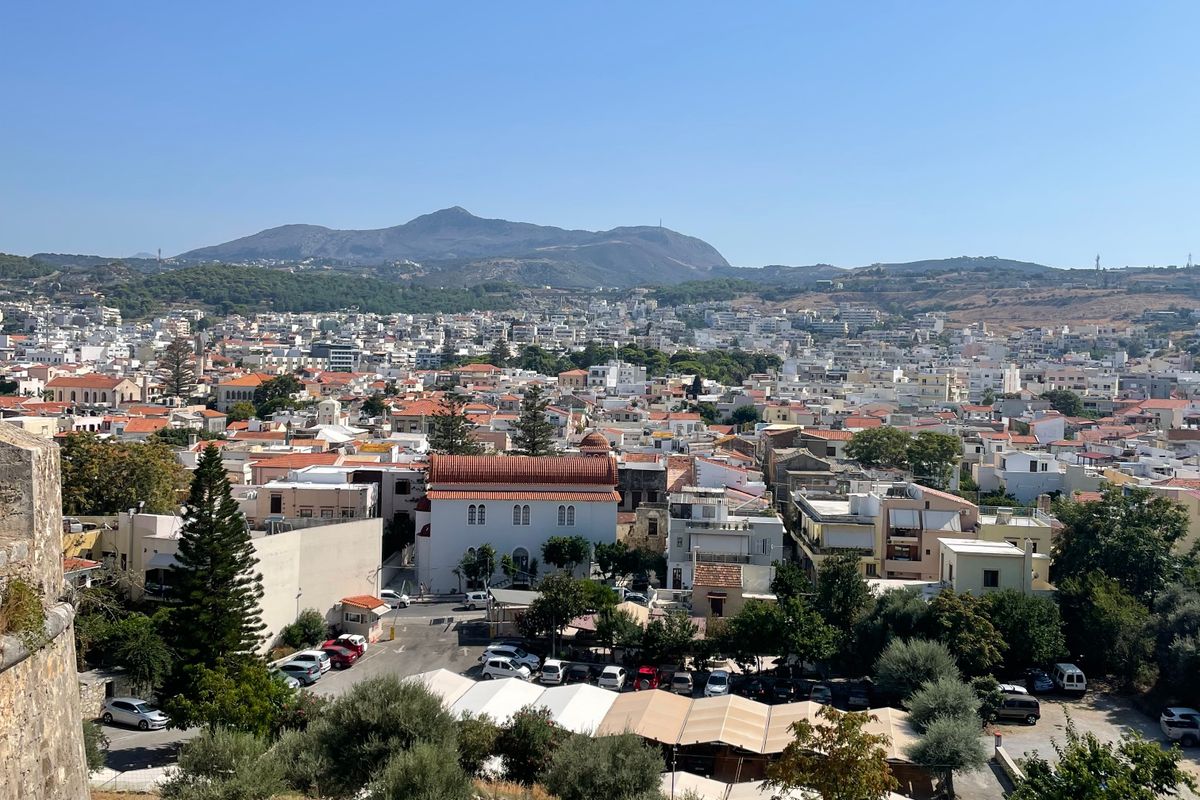
The Fortezza, and what it is actually for
Start high. The Fortezza is the great hilltop citadel the Venetians threw up on the Paleokastro headland after pirates and then an Ottoman raid made the point that the town below could not defend itself. Building ran through the middle of the sixteenth century; the Ottomans took it anyway in 1646, after a long siege, and it has been weathering on its rock ever since.
Inside the walls it is more open ground than ruin — grass, low bastions, the shell of buildings, and a domed structure at the centre that was the garrison church before it became a mosque. That is the short version of Crete in one building: a Catholic fort, an Orthodox island, an Ottoman conversion, all stacked on the same foundations.
What earns the climb, though, is the edge. From the seaward ramparts the whole coast unrolls — the harbour directly below, the long beach running east, the mountains behind town. Go late in the day if you can. The honey-coloured stone takes the low sun well, and the heat eases.
The fortress is not a museum so much as a high terrace with five centuries of masonry attached. You pay a few euros, you walk the walls, you watch the light change on the roofs. That is the whole transaction, and it is a fair one.
Down in the lanes
Off the headland, the old town is a tangle of narrow streets that has barely been straightened in four hundred years. This is the part Rethymno does better than anywhere on the island. Venetian doorways with carved stone surrounds. Above them, wooden Ottoman balconies — the enclosed, latticed kind, called sachnisi, jutting out over the lane on timber brackets. You rarely see the two traditions sitting on the same façade as plainly as you do here.
Three things are worth aiming for as you wander, though half the pleasure is getting pleasantly lost between them:
- The Rimondi Fountain — a small Venetian fountain from 1626, set into a corner with three lion-head spouts and a row of slim columns. It is modest, and it is one of the prettiest single objects in the town. Locals still use the little square around it as a meeting point.
- The Neratze Mosque — once a Venetian church, converted under the Ottomans, and crowned in 1890 with the tallest minaret in Rethymno. It is the clearest Ottoman mark left standing. The building now serves as a music conservatory, so on a good evening you may hear it before you see it.
- Everything in between — the bougainvillea over the doorways, the cat asleep on a step, the shop selling nothing you need. The lanes reward slowness more than any single monument does.
The harbour and the little lighthouse
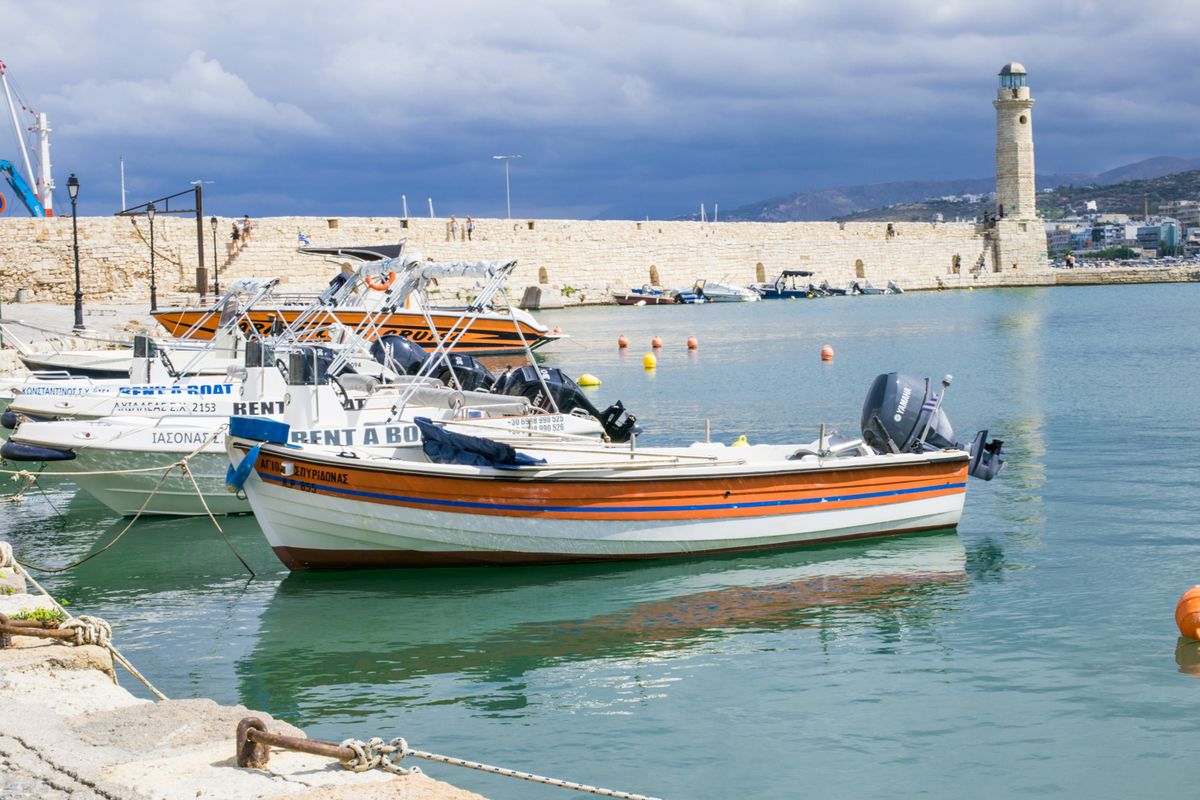
Down at sea level, the Venetian harbour is small — a curve of stone quay, a row of fishing and rental boats, and tavernas filling every metre of waterfront with tables and laminated menus. We will be honest: the food right on the harbour is priced for the view and rarely worth it. Eat a street or two back. But walk out along the breakwater to the lighthouse, which is squat, round and built of pale stone — a short Egyptian-era tower from the early nineteenth century, not the slim Venetian kind you may be picturing. It is the postcard shot of Rethymno, and unlike a lot of postcard shots it is genuinely a nice five minutes.
A beach inside the town
Here is the thing the old-town photos never show: the beach starts where the town ends. Step out past the marina and you are on a wide band of soft sand that runs east for miles. It is municipal, it is busy in summer, and it has all the umbrellas and snack bars that implies — but it also means you can spend a morning among carved Venetian doorways and an afternoon flat on the sand without moving the car. Few towns of any age let you do both on foot.
Walk far enough east along it and the crowds thin to almost nothing. The quality of the sand holds the whole way.
The university makes it cheaper
Rethymno has a chunk of the University of Crete, which changes the feel of the place out of all proportion to its size. There are students, which means there are cheap places to eat and drink that stay open late and are not aimed at tourists. The evening crowd in the lanes is as likely to be local as visiting. It is the difference between a town that lives and a town that performs, and it is the main reason we keep coming back.
Practicalities, in one breath. Rethymno works as an easy half-day stop on the north-coast road, or as a calmer base for the western half of the island. KTEL intercity buses link it to both Heraklion and Chania along the coast, and the station is a short walk from the old town. Driving in, do not try to take a car into the old quarter — the lanes are stone-narrow and half pedestrian. Park outside the walls, on the beach side or near the public lots, and walk in. A half day covers the fortress, the lanes and the harbour comfortably; stretch it to a full day if you want the beach too.
So is it worth stopping?
Yes — and we would go further. Set beside Chania, the more famous Venetian harbour town an hour west, Rethymno is the quieter, cheaper, slightly smaller version, and it is nearly as good-looking. You give up a little grandeur and a few photogenic angles. You gain elbow room, lower prices and a town that still belongs to the people living in it. If Chania is the headline, Rethymno is the better afternoon. It is one of the few places on this coast that genuinely asks you to slow down, and one of the few worth obeying.