South · Coast
Matala and the south coast
A sandstone wall full of holes, a bay that faces Africa, and a village still selling 1969 by the postcard. The caves are the reason to come; the Messara behind them is the reason to stay.
The first thing you notice at Matala is not the caves. It is the colour of the cliff — a pale, biscuit-toned sandstone the afternoon light turns almost gold, against water from jade to deep open-sea blue. The caves come second, once your eye adjusts to the whole rock face being perforated, row upon row of dark square mouths cut into the soft stone. People carved those — a long time ago, and, in a way, not so long ago at all.
Matala sits on the Libyan Sea, the south-facing coast of Heraklion province, roughly an hour's drive down from the city across the wide farmland of the Messara plain. We came expecting to be cynical. We left having stayed for the sunset twice.
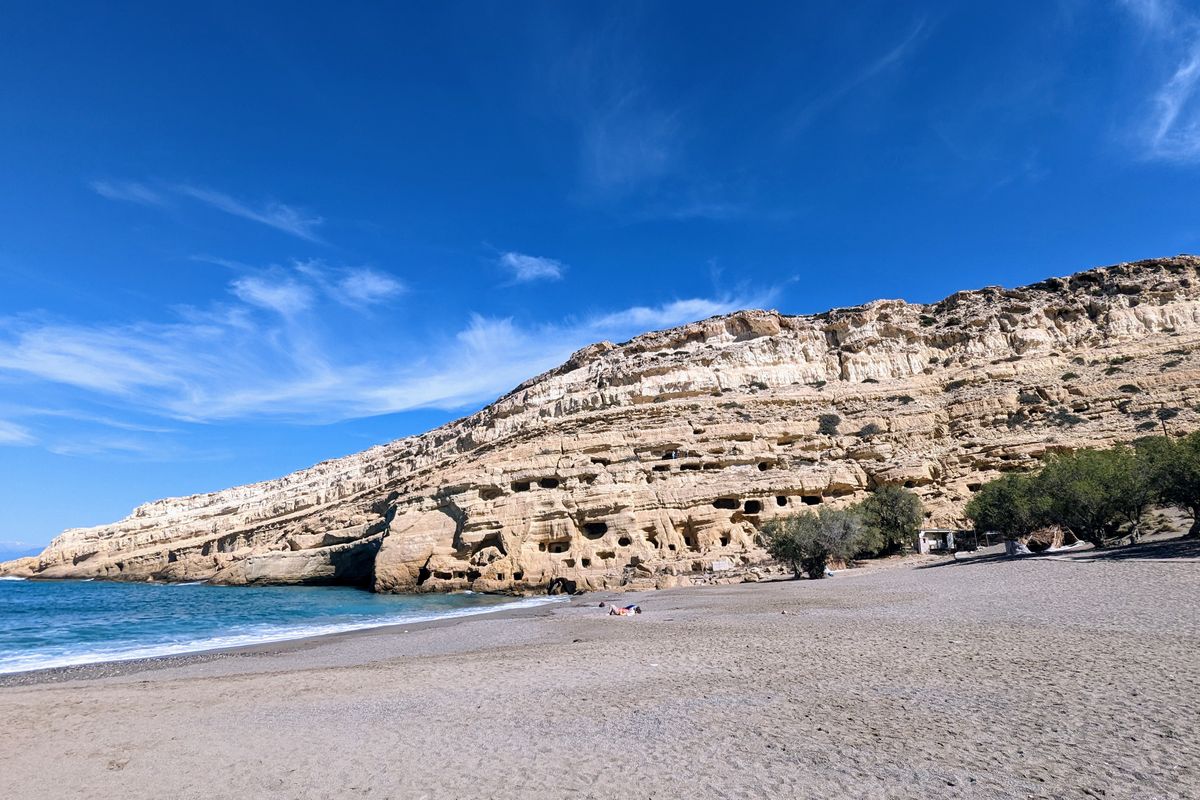
The holes in the rock, and who slept in them
The caves are man-made and old, chiselled into the sandstone in antiquity and used as rock-cut tombs in Roman times — the openings squared off, some with rough steps and recesses inside. For most of their existence they were exactly that: a burial place, quietly weathering above an empty beach.
Then the late 1960s happened. A loose international crowd of travellers, drop-outs and musicians moved into the caves and stayed, sometimes for years, turning the tombs into rent-free apartments with a sea view. Joni Mitchell passed through and carried the place into a song — "Carey," off Blue, is Matala set to a guitar, the cave and the wind off the water. The commune broke up by the mid-seventies when the authorities cleared the caves; the village has been selling the memory ever since.
Tombs first and a commune second — a strange order of events to stand in front of. You climb to a square opening worn smooth by Roman hands and 1971 sandals alike, and the wind off the Libyan Sea does the rest.
Today the cliff is a fenced archaeological site. You pay a small entrance fee, climb the cut paths between the levels, and can sit in the mouth of a cave looking straight out at the water. It closes in the evening, gates down well before the light goes — so go in during the afternoon, then come back out for the sunset from the beach or a bar, which costs nothing and is honestly the better view.
What the village is, and what it pretends to be
Let me be straight about Matala village. It trades hard on faded-hippie kitsch — peace signs on walls, a "Today is life, tomorrow never comes" slogan over the road, tie-dye in every shop window, a strip of tavernas all on roughly the same playlist. A theme park built around a feeling that left fifty years ago.
And yet. Strip the merchandise away and the bones are real: a beautiful curved bay, a cliff full of genuine antiquity, and a sunset dead ahead over the sea. Order a drink, face the water, and the place stops trying to sell you anything.
Caves run on opening hours and a ticket; the sunset does not. Do the archaeological site in the afternoon, then keep the evening free for the beach — the best light arrives after the gates have closed for the day.
A few practical notes worth having before you go:
- Getting there: roughly an hour from Heraklion, mostly fast road across the Messara, then a winding descent to the coast. A relaxed day trip, or a low-key base if you want to slow right down.
- The fee: the cave site charges a small entrance fee that goes toward preservation. Bring a little cash and don't expect to wander in after dark.
- Parking and August: the village is tiny and the high-summer crowds are not — arrive early, or come outside July–August.
- Shade and footing: the cliff is bright, hot stone with little cover. Hat, water, and shoes that grip — the cave paths and the Red Beach scramble punish flip-flops.
Red Beach, for the people who walk
The main bay is fine, but the better swim is over the headland. Red Beach — Kokkini Ammos — sits on the far side of the rocky spur to the south, and the only way there on foot is a 20-to-30-minute scramble up and over. It is a proper little hike: a stony path, some loose footing near the top, then a steep drop down to a reddish cove that the Libyan Sea has half to itself.
Space is the reward. Fewer people make the walk, so the cove stays calmer than the main strip even when Matala is heaving. It has long had a free-and-easy, clothing-optional reputation — go knowing that, and take water, because there is next to nothing in the way of services down there.
If a scramble is not your idea of a holiday, skip it without guilt — the main beach has the sunbeds, the tavernas and the easy water entry. Red Beach is for people who like to earn the swim, and it does reward the effort.
The Messara, which is the real reason to stay
Here is the part the postcards underplay. Matala is the coastal end of the Messara, the largest, most fertile plain on Crete, and the land behind it is stacked with sites you would build a whole trip around elsewhere.
Phaistos is the headline: the second great Minoan palace after Knossos, on a hilltop with a long view to the mountains. It is quieter and far less reconstructed than Knossos — you read the ruins as ruins, with the wind and the wheat instead of crowds. Down the road sits Gortyna, the sprawl that became the Roman capital of the island, with its famous inscribed law code and a basilica in the olives. Both fold into a single morning, close enough to Matala that you can do ancient stone before lunch and sea after it. Our guide to the museum that holds the Minoans is a useful bookend — the finds from Phaistos largely live there now.
For more sand, Kommos is a long, broad beach a short way north, with a Minoan harbour site at one end and far more towel room than the main Matala bay. Further west, beyond the province line, Preveli rewards a bigger detour: a palm-lined river meeting the sea where the Kourtaliotiko gorge spills out, reached by a steep stairway down. None of it is on the way to anywhere, which is exactly why it stays good. The driving between these scattered points is half the planning, so it's worth reading up on getting around Crete first.
How we would actually do it
Given a single day from Heraklion: across the Messara early, Phaistos and Gortyna while the stone is still cool, lunch at a plain village or at Kommos, then the Matala caves through the bright afternoon and the sunset from the bay. A second day buys you the Red Beach scramble in the morning and an afternoon left empty on purpose.
This coast moves at a different speed from the north, and you'll eat better off the tourist strip than on it; our notes on the Cretan table cover where to look. Matala judged on its souvenir shops is a half-hour and a shrug. Matala as the doorstep to the Messara — caves, palaces, a Roman capital, beaches the crowds skip — is worth real time. That cliff full of holes is just where you start.